
From the Olympics to the Super Bowl, everyone’s minds seem to be on sports. In this issue of FSB Fun Facts, we will pull back the curtain and reveal how science shapes sports. From tennis to frisbee, golf to surfing, physics plays a role in these games.
How does the spin of a tennis ball influence its trajectory?
Spin is one of the most important aspects of tennis because it allows a player to control the flight path of the ball. The spin on a serve can cause a ball to float in the air, curve sideways, or dive. The Magnus effect, which describes the interaction between a moving object’s spin and a fluid (air), explains how spin influences a ball’s trajectory. When a spinning ball moves through the air, the ball drags some of the air around with it. The drag on the side of the ball turning into the air slows the airflow, while speeding up the airflow on the other side of the ball. The pressure is higher on the side of the ball where airflow is slowed, which forces the ball toward the lower-pressure area on the opposite side. Topspin causes the trailing air to flow upward, which pushes the ball down. Backspin causes the trailing air to flow downward, which pushes the ball up and helps it resist the force of gravity.
Which forces influence the flight of a Frisbee?
Drag, lift, and spin all play a role in a Frisbee’s flight. Lift, which is explained by Bernoulli’s Principle, allows the Frisbee to stay airborne. The curved shape of the Frisbee causes the airflow above it to travel at a higher velocity than the airflow underneath. This creates lower pressure above and higher pressure below the Frisbee. The pressure difference provides lift. Drag, which is perpendicular to lift, acts against the Frisbee’s movement through the air. The angle at which the Frisbee is thrown affects both lift and drag. To fly well, a Frisbee needs enough lift and not too much drag. Without spin, a Frisbee would flutter to the ground like a leaf. Spinning helps keep the Frisbee stable by supplying angular momentum–the faster the spin, the more stable it is. This phenomenon is known as gyroscopic stability, which refers to the tendency of a rotating object to maintain its orientation and resist changes in its axis of rotation. This is due to the angular momentum generated by the rotation, which creates a force that opposes any external torque attempting to alter its direction.

How do the dimples on a golf ball influence its flight?
The dimple patterns of a golf ball influence trajectory, peak height, angle of descent, and overall distance. Dimples reduce drag while the ball is in the air; this influences airflow and increases lift, helping the ball travel farther with a more stable trajectory. The shape, depth, edge angle, and number of dimples all play a role; shallower dimples result in a higher trajectory, and deeper dimples result in a lower trajectory. Golf balls are designed to achieve specific flight profiles. According to Titleist, when its engineers design balls, they make adjustments as precise as 2/10,000 of an inch—roughly the size of a red blood cell—to maximize a golf ball’s aerodynamic performance.

What influences the height and distance of a football punt?
When a punter kicks a football, they control the speed at which the ball leaves their foot, the angle of the kick, and the rotation of the ball. The ball’s velocity and kick angle are the primary factors determining how long it remains in the air, how high it goes, and how far it travels. If a ball is kicked at a steep angle, it has more velocity in the vertical direction than in the horizontal direction. As a result, the ball will go high and have a long hang-time, but it will only go a short distance. If the ball is kicked at a shallow angle, it will have more horizontal velocity than vertical velocity—the ball will not go very high and will have short hang time, but it will travel far. The rotation of the ball also plays a role. It impacts air drag, which influences the rate at which the ball slows down in flight. A spiraling kick has less air drag than an end-over-end kick, so it does not slow down as much and can stay in the air longer and travel farther.
What forces influence the movement of a surfboard?
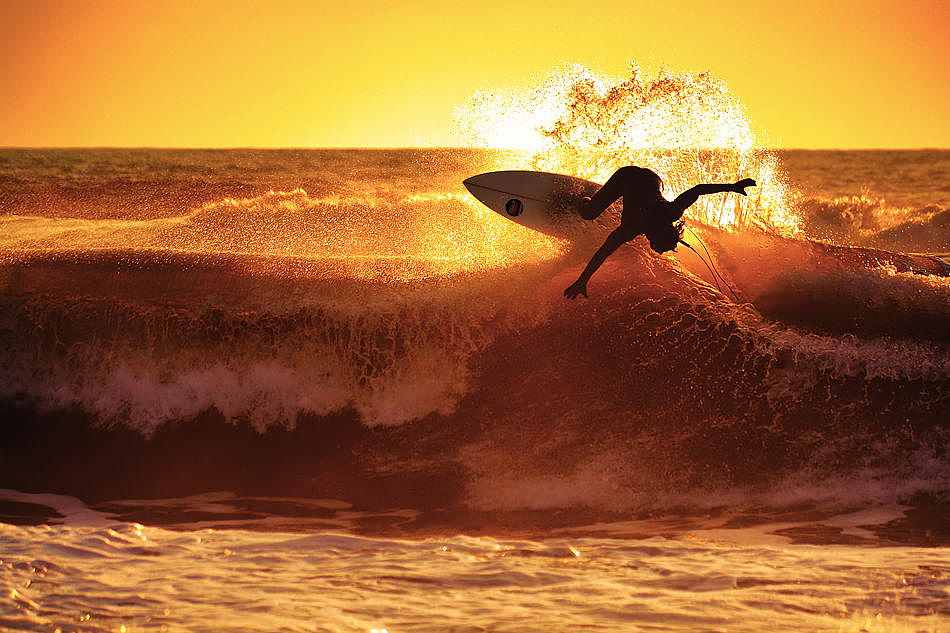
When a surfer is at rest on their board waiting for a wave, the gravitational force pulling the board down and the buoyant force pushing the board up are equal and opposite. As the wave gets near, the surfer paddles to match the wave’s speed. As the surfer catches the wave, the surfboard accelerates. The board forms an angle with the water, creating pressure on its underside that forces the surfboard out of the water and causes it to skim the surface. The increased forward momentum makes the surfer more stable, enabling them to stand up and surf the wave. The position of the surfer’s body also influences the movement of the board. The fins on the surfboard allow a surfer to alter their speed and direction as they reposition their weight.
Sources:
Cover Image: 500pxBlog
https://www.britannica.com/science/Magnus-effect
https://www.scientificamerican.com/article/bring-science-home-frisbee-aerodynamics/
https://www.titleist.com/learning-lab/understanding-aerodynamics-and-ball-flight


 The Fieldston Science Bulletin
Leave a comment