
By: Lucia Mastroianni
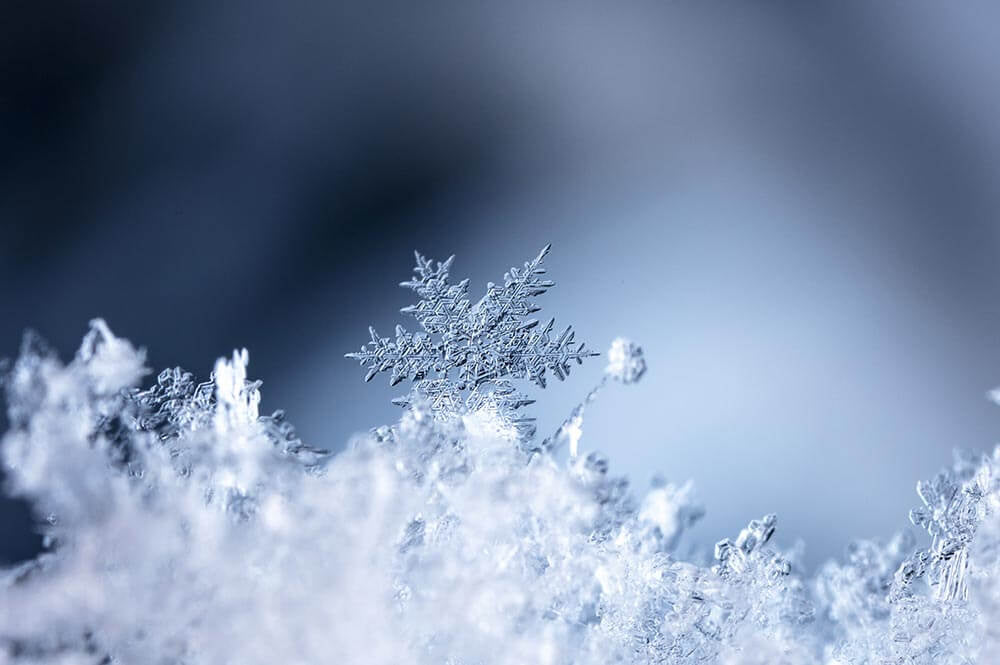
In the months of December, January, and February, the air gets colder and the precipitation that falls on us from the clouds is not rain, but small delicate crystals that combine to make the fluffy snow that brightens our winters. Snow is defined as atmospheric water vapor frozen into ice crystals and falling in light white flakes. But how does the water suddenly create these beautiful snowflakes, each with a unique pattern?
Snow originates from water vapor within clouds when their temperature is below freezing (32 degrees F). Clouds play a major role in the creation of snow, and the type of cloud is significant. cumulonimbus and nimbostratus clouds contributing most to snowfall. Cumulonimbus clouds are dense, towering storm clouds with strong updrafts. They carry water vapor high up to colder atmospheric temperatures making the forming of ice crystals easy. They also produce heavy precipitation, producing heavy snowfalls. Nimbostratus clouds are thick, dark gray clouds that cover the sky and produce continuous, steady precipitation over a wide area. Unlike cumulonimbus clouds, they are ideal for accumulating significant snowfall rather than short snow storms because of their depth, moisture, and prolonged, consistent output
Snowflakes begin to form when tiny water droplets help within clouds freeze onto pollen or dust particles. As this primary crystal falls towards the ground, water vapor attaches to the existing crystal and freezes, this is how the branches on a snowflake normally form. The water droplets instantly freeze when they come in contact with these particles in the atmosphere because the water is supercooled. Supercooled water is liquid water that’s cooled below its normal freezing point but hasn’t frozen because it lacks “nucleation sites” (dust, particles) for ice crystals to form on, allowing it to remain liquid until disturbed, which triggers rapid freezing.
The reason snowflakes are symmetrical is due to the underlying chemistry of a water molecule. Water molecules naturally arrange into a hexagonal (six-sided) crystal lattice due to hydrogen bonding. A water molecule (H2O) has a bent shape, with hydrogen atoms on one side and an oxygen atom on the other. These molecules form strong hydrogen bonds with neighbors, creating stable, ordered arrangements. The most stable and common way for water molecules to bond is in a hexagonal structure with 120-degree angles between molecules. Therefore, as water molecules begin to freeze over dust particles and water vapor attaches, this hexagonal structure stays.
The temperature at which these crystals form is also incredibly important to their making. This temperature determines the basic shape of the snowflake. We see long needle-like crystals at 23 degrees F and very flat plate-like crystals at 5 degrees F. The shape of the arms of the snowflakes are also dependent on atmospheric conditions as the ice crystal falls. A crystal may begin to grow arms in one manner, and then minutes or even seconds later, slight changes in the surrounding temperature or humidity causes the crystal to grow in another way.
This creates extreme variability that causes no two snowflakes to be exactly alike. Individual snowflakes all follow slightly different paths from the sky to the ground and encounter slightly different atmospheric conditions along the way.
Snow is such a natural phenomenon that many do not realize the incredible underlying chemistry and variability of snowflakes and snowfall. Next time you see it snow, try to catch a few snowflakes on your jacket and admire the patterns made up of water vapor and dust particles from the atmosphere.
Source:
Cover Image: Ocean Gate
https://www.noaa.gov/stories/how-do-snowflakes-form-science-behind-snow
https://www.americanscientist.org/article/the-formation-of-snow-crystals



 The Fieldston Science Bulletin
Leave a comment