
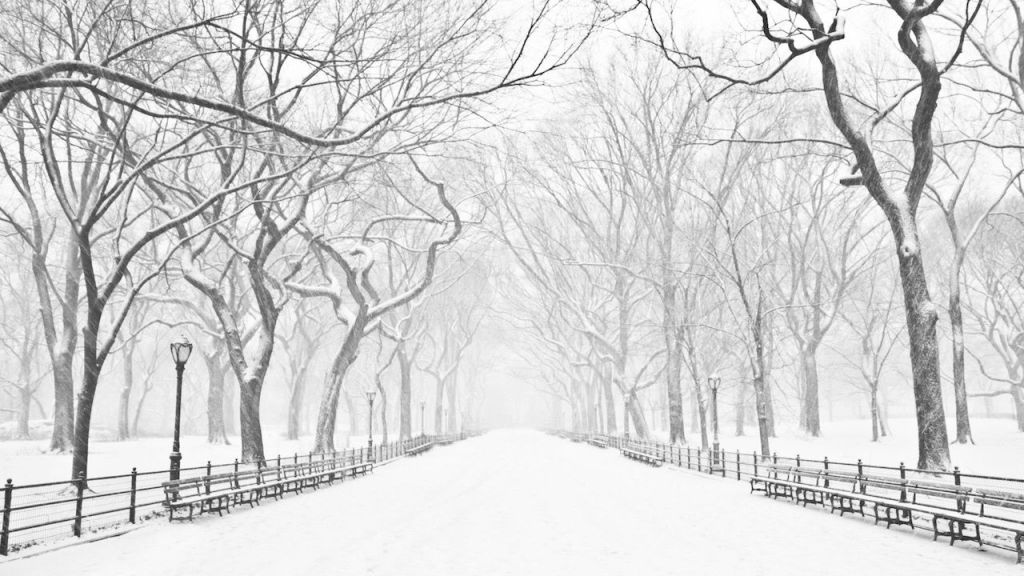
Winter is finally upon us!
While everyone decks the halls and trims the tree to ring in the snowy season, here at the FSB we are once again diving into the science of the season with this set of fun facts. Want to know more about icicles and polar bears? Want to properly understand what we mean when we say frost? You’ve come to the right place!
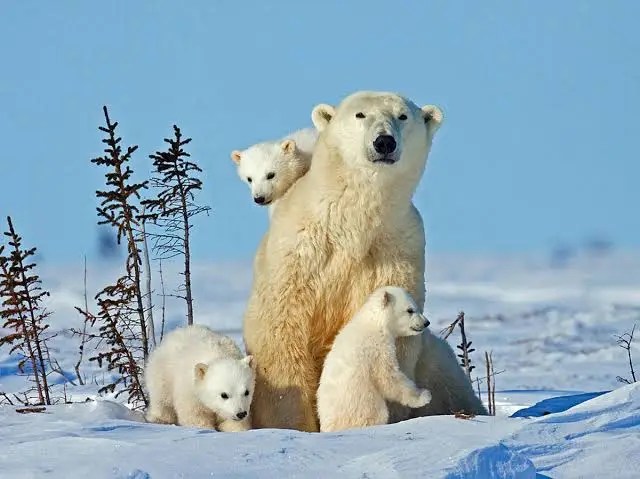
1. What physical adaptations help polar bears survive in the Arctic?
Polar bears have several physical adaptations that help them survive the harsh winter cold and the long summer days in the Arctic. These adaptations include:
Their paws are adapted to the ice:
Polar bear paws are large, so their weight is distributed over a larger area, which is advantageous when walking on thin ice. Their claws are non-retractable and shorter compared with the claws of other types of bears and their paw pads have bumps (papillae). Together, these features function like ice cleats, which help polar bears grip the ice.
Their fur and skin have adaptations that insulate them and prevent over heating:
Polar bears have black skin with a blubber layer (2.5-5 inches thick) beneath it that prevents heat loss. Their skin is covered by dense fur consisting of two layers: a thick underfur topped by long, oily guard hair that prevents water from reaching the underfur. Polar bear fur is transparent; each hair has a hollow core that reflects and scatters visible light, like snow and ice. This prevents overheating under the intense summer light.
They have powerful night vision and can see underwater because their eyes have a high concentration of rod cells.
2. Why does salt melt ice?
Salt melts ice by lowering the freezing point of water, a phenomenon known as freezing-point depression. When dissolved in water, salt breaks down. For example, a molecule of table salt (sodium chloride, NaCl) dissociates into a sodium ion and a chloride ion. A molecule of calcium chloride(CaCl 2 ), a type of salt used on streets, breaks down into one calcium ion and two chloride ions. The ions interfere with the water’s ability to form the rigid structure characteristic of ice, thus lowering the freezing point of water.
Salt is used to prevent streets from icing over because it reduces the freezing point of the water on the ground, so it no longer freezes at 32°F. The higher the salt concentration, the lower the freezing point. For freezing-point depression to work, there must be at least a small amount of water on the road to dissolve the salt. This is why roads are pretreated with a brine solution (a mixture of salt and water) when ice and snow are forecast.
3. How does frost form?
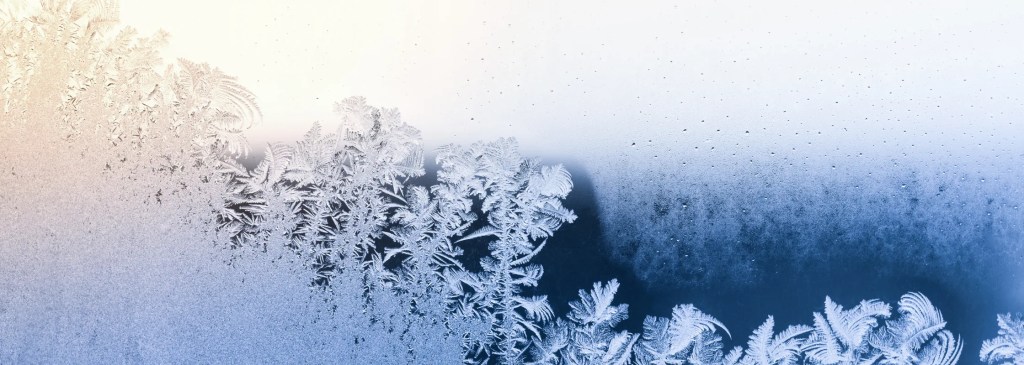
Frost forms when water vapor comes into contact with a surface below the freezing point of water (32°F/0°C). At this temperature, the moisture in the air freezes. There are different types of frost, including radiation frost (hoarfrost), advection frost, window frost, and rime.
- Radiation frost (hoarfrost) is a collection of tiny ice crystals. It forms on exposed areas outside and in refrigerators and freezers.
- Advection frost typically forms as small ice spikes. It forms when cold wind blows over surfaces such as tree branches or poles.
- Window frost forms when a window is exposed to cold outdoor air and warm, moist indoor air, resulting in frost on the inside of the window.
- Rime forms quickly when an icy object comes into contact with a wet surface. It often forms on aircraft when they encounter clouds and on ships operating in very cold regions, such as the Arctic Ocean.
4. What gives icicles their distinct shape?
Icicles form when water drips in subfreezing temperatures. Once the first drop freezes, another drop follows and freezes, and so on and so on, but what is the science behind their unique shape?
Icicles are covered with a thin film of water. As a new drop of water travels down the icicle and freezes, the molecules release heat, which keeps the film of water covering the icicle from freezing. Heat is also released into the air around the icicle. The combination of the water flowing down and the warm air flowing up produces a long pointy shape that is thicker at the top and thinner at the bottom. The bumps, or ripples, on the icicle are caused by impurities, such as salt and/or minerals dissolved in the water. According to scientists, icicles made from distilled water, which has no impurities, are smooth. The higher the concentration of contaminants in the water, the fatter the bumps.
Sources:
Cover Image: Live Science
https://iere.org/how-do-polar-bears-adapt-to-their-environment/
https://www.worldatlas.com/articles/how-is-the-polar-bear-adapted-to-its-environment.
https://www.thoughtco.com/why-does-salt-melt-ice-607896
https://www.britannica.com/story/why-does-salt-melt-ice
https://science.howstuffworks.com/nature/climate-weather/atmospheric/road-salt.htm
https://education.nationalgeographic.org/resource/frost/
https://www.weatherbug.com/news/Frost-What-Causes-This-Phenomenon
https://www.foxweather.com/learn/how-do-icicles-form
https://www.abc27.com/winter-in-central-pa/how-do-icicles-form-and-are-they-dangerous/



 The Fieldston Science Bulletin
Leave a comment