
By: Cristina Ellis
The holiday season has become inextricably intertwined with the idea of snow. From songs such as Bing Crosby’s, I’m Dreaming of a White Christmas, to movies filled with snowy holiday magic, the idea that it should snow during December has proliferated the public consciousness. So why is it that so often our Decembers are utterly devoid of snow? The answer is simple, it is snowing less.
Global warming has driven the average temperature of the Earth up by around 2.11℉. You might think the implications of this small shift aren’t that meaningful, but even small shifts in average temperature can change weather patterns. For example, during the last ice age, the average temperature of the Earth was about 11℉ cooler than it is currently. At that time, vast swaths of the earth were covered in glaciers, including the entirety of Canada and the northern United States. Sea levels were far lower, exposing masses of land that are currently underwater, linking several continents to various islands.
But what does all of this have to do with snow? Well, it does not take that much of a decrease in average temperature to create an icy world, so conversely, it is logical that as the average temperature of the Earth increases, the amount of snow and ice will decrease. Justin Mankin, an associate professor of geography at Dartmouth who co-authored a study on the the impact of climate change on Earth’s snowcap, told CNN that we shouldn’t expect a gradual linear decrease in the amount of snow, instead once the planet reaches a certain temperature, “we should expect the losses to accelerate.” Mankin continued by stating that it is nowhere safe from the decline in snow, “We can expect a lot of the places that haven’t exhibited massive snowfall declines to maybe start to exhibit them with just a little bit more warming.”
According to CNN, since 1973, there has been a 2.7% decrease in snow across the globe, particularly affecting the northern hemisphere’s middle latitudes, where the United States is situated. In parts of the southern and western United States, there has been a 30% decrease in snow totals. This decrease has very serious implications for people who live in these regions because melting snow, aptly called snowmelt, is a crucial source of water. As the amount of snow continues to decrease, that supply is drying up, resulting in droughts. This problem is not unique to the United States, as parts of southern Asia, the Mediterranean, and Northern Africa also rely on snowmelt as a source of water. Unless we make a significant changes in how we address climate change and this pattern of reduced snow is reversed, significant changes to water distribution systems will be needed.
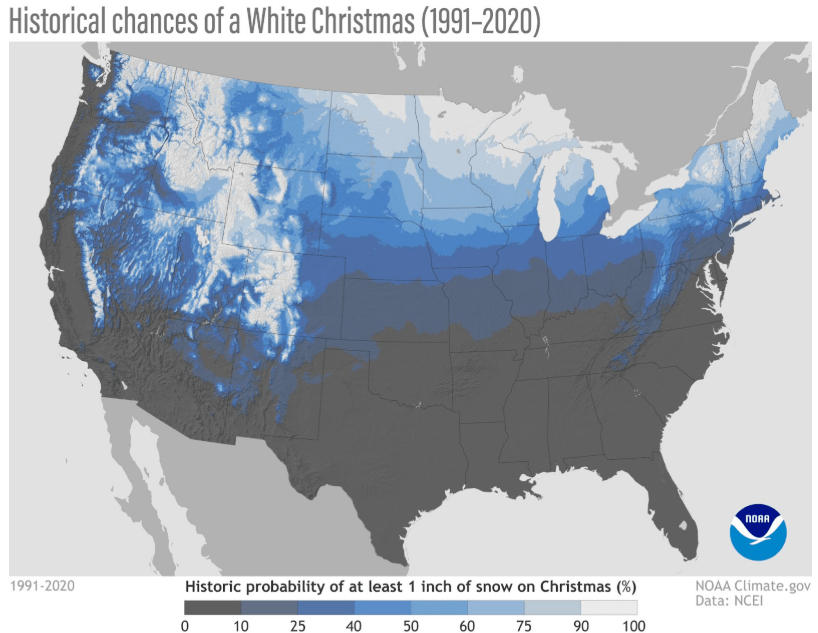
But now, before we conclude this article, let’s return to the question of whether we can look forward to snow this holiday season. In the Greater New York City area, during the past thirty years, 10 percent of Christmases have had at least one inch of snow. While this statistic may be discouragingly low, it is important to remember that the Holidays are a time of hope. In addition to wishing for a happy holiday with friends and family, wish for more snow, not only here, but around the world.
Source:
https://www.cnn.com/2023/11/25/weather/snowfall-temperatures-climate-change-water
Featured Image Source: Hotel Beacon



 The Fieldston Science Bulletin
Leave a comment