
By: FSB Team
Saint Patrick’s Day is heavily associated with Ireland and has a number of distinct symbols and icons. Here are some fun facts about some of these icons and the Emerald Isle itself.
1. How rare is a four-leaf clover?
Clover is the name commonly used for plants of the genus Trifolium (from Latin tres ‘three’ and folium ‘leaf’). There are about 300 species of clover, and they can be found in North America, Europe, South America, Africa, and even in the tropics (on mountains at high altitudes). Only about 1 out of 10,000 clovers have four leaves. Rare genetic mutations are responsible for four-leaf and higher-leaf versions of clovers. According to the Guinness Book of World Records, the most leaves ever found on a clover are 18. This specimen was found by a man in Japan in 2002.
2. Why are emeralds green?

Emeralds are a variety of the mineral beryl (Be3Al2Si6O18), which is composed of beryllium and aluminum silicate. Other members of the beryl family include the gemstones aquamarine and morganite. Emeralds are green because they have trace amounts of chromium and vanadium, which cause the stone to reflect green light. The shade of green depends upon the amount of each element that is present.
3. What is the “soda” in Irish soda bread?
Irish soda bread is a type of quick bread in which baking soda (sodium bicarbonate – NaHCO3) is used as a leavening agent instead of yeast. Traditionally, it has four ingredients: flour, baking soda, salt, and buttermilk. When soda bread is made, the lactic acid (C3H6O3) in the buttermilk reacts with the baking soda to produce carbon dioxide (CO2). The carbon dioxide bubbles cause the dough to rise and produce the series of interconnected pockets in the bread.
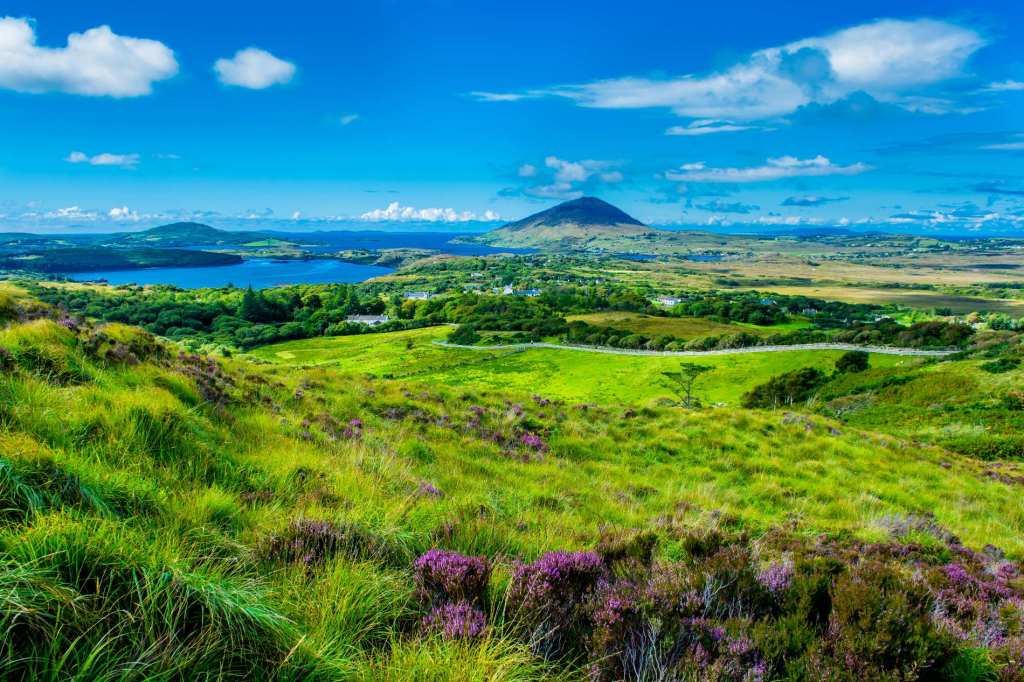
4. Why is Ireland so green?
Ireland has the ideal conditions for plant life. As a result of its location at the edge of the Atlantic Ocean, oceanic weather systems produce ample rainfall. It can rain 150-225 days a year, depending on the region. A warm ocean current known as the North Atlantic Drift keeps the climate mild, characterized by cool summers and relatively warm winters. As a result, plants are not scorched by summer heat or killed by winter frosts. Finally, Ireland has rich fertile soil formed over thousands of years by volcanic activity, glaciers, and ancient rivers.
5. Why is gold the most malleable metal?

Leprechauns are not the only ones who value gold. It has been popular for thousands of years, not just because of its beauty but also because of its physical properties. Gold is the most malleable and most ductile metal; it can be beaten into sheets as little as 0.00013 mm (.13 microns) thick and drawn in wires with diameters as small as 0.01 mm (10 microns). Gold owes its physical properties to its atomic structure and the way its atoms bond together. At an atomic level, it has a face-centered cubic crystal structure (each atom is surrounded by 12 neighboring atoms) which permits atomic planes to glide over one another with very little friction Additionally, it has metallic bonds in which the outermost electrons of each atom are free to move around the overall structure of the material. This delocalized electron cloud allows atoms to move past each other without breaking off, which makes it possible to both stretch and flatten the metal.
Sources:
Thompson, Andrea. “Why Do Some Clovers Have Four Leaves?” Live Science. March 17, 2010. https://www.livescience.com/32221-why-do-some-clovers-have-four-leaves.html.
“Why Are the Emeralds Green?” Emerald By Love. August 12, 2024. https://emeraldbylove.com/blogs/news/why-are-the-emeralds-green.
“Seeing Green: All About Emeralds.” GIA. Accessed March 12, 2025. https://www.gia.edu/seeing- green#:~:text=Emeralds%20are%20formed%20when%20chromium,the%20ston e%20a%20bluish%20tint.
Connor, Nick. “Gold – Crystal Structure.” PeriodicTable.Org. November 13, 2020. https://www.periodic-table.org/gold-crystal-structure/.
Choi, Charles Q. “Why Is Gold so Soft?” Live Science. July 30, 2023. https://www.livescience.com/chemistry/elements/why-is-gold-so-soft.
Irish Central Staff. “Why Is Ireland so Green? The Science behind the Emerald Isle’s Famous Hue.” Irish Central. October 1, 2024. https://www.irishcentral.com/travel/why-ireland-green.
Morrissey, Ellen. “All About Traditional Irish Soda Bread—And the Best Way to Enjoy It.” Martha Stewart. February 28, 2023. https://www.marthastewart.com/8038033/irish-soda-bread-explained.
Featured Image Source: Tourism Ireland




 The Fieldston Science Bulletin
Leave a comment